In August 2026, ESH studio and its partners, Valera, Philipp and Stephan, discussed the application of AI instruments in our industry. The conversation revealed a complex subject which we thought needed to be brought into the public eye.
We found ourselves in a situation, where markers of quality are shifting. Production of visual content is almost free, and the staff’s productivity is valued higher than their skill level.
Recently, we couldn’t defend production of live-action video for the large brand. The reason was that real video could cost dozens of times more than AI-character content. The outcome was the decimation of our hand-crafted graphic elements by the signature AI-generated featureless ‘charisma’. The quality lost its battle with productivity and effectiveness. But this loss could not be argued because of the clear budgeting advantage that the final decision has brought.
AI criticism, whether it’s about copyright, the distribution of power or the consequences of its wide-scale implementation, is difficult to comprehend and evaluate. Providing arguments against the use of technology takes time, demands context and the ability to see further than current brief and contract. These arguments are often defeated by the reality of budgeting.
Phillip brought a crucial point —
We as professionals have an expertise and a right to argue for and justify the values we believe in.
Sure, the market may demand any product and result. But the area between the desirable outcome and the functioning product is mediated by professional knowledge, and it’s still us, not neural machines, who are responsible for it.
If this responsibility is taken away, then the role of the designer is reduced to primitive mechanical operations (according to the concept of deskilling). The designer will become a pixel pusher. This role is very favourable for both market and consumer society because it implies maximized productivity. As Stephan said, this is the progress which is inevitable after all.
But at least now the expertise is still a part of design, and we have to understand what constitutes its value and how it is transformed.
Now every design bureau and specialist is expected to react to the AI boom. At least to demonstrate how effectively they use AI tools and, at most, to have their own AI vision.
The default demands are:
- public conformity with the view that this technology is inarguably important;
- recognition of its potential;
- at least a display of curiosity about its possibilities;
The industry demands a positive reaction to AI.
A telling example of this is the Porto Rocha agency, which issued their AI statement and labeled their attitude towards AI as critical optimism. That statement stirred a discussion that juxtaposed it with their own statement regarding free pithches, which were defended by the agency in 2024.
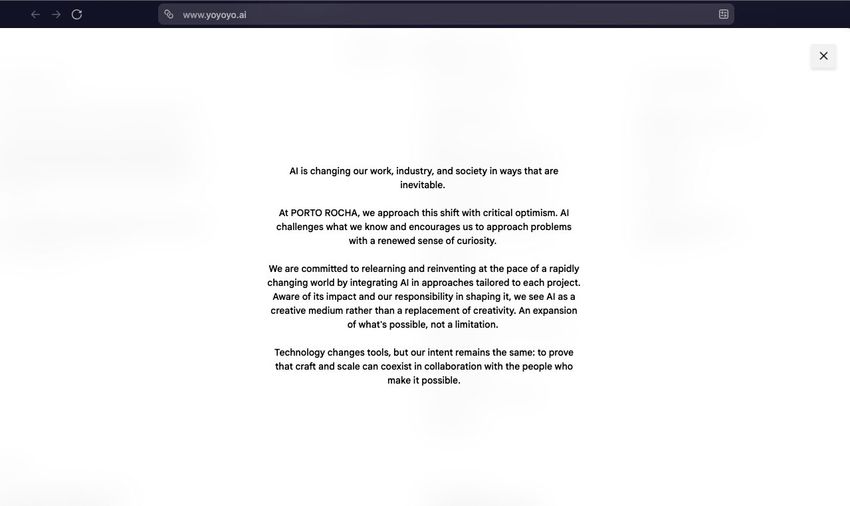
Our attention is caught not by the statement itself and its inconsistency, but by the function which such statements start to serve. The position of such a credible agency becomes part of a script which shapes the general sentiment of the industry regarding the technology. Hence, it’s important to look not just at the statements, but at the overall context in which they appear.
The control over capital and their production infrastructure by designers is long gone (which was still the case 150 years ago among dockworkers and textile workers), and now our field comfortably sits within the neoliberal framework, which demands achievements and exponential growth, their visibility and reproductivity, innovation and a sense of progress. Multiplicity, automation and speed are the markers of productivity and, by default, are considered positive.
To argue otherwise is harmful and not beneficial, as it runs counter to progress and, therefore to business, as well as the moral imperative of productivity. Any criticism concerning AI is labeled as technophobic. This might be compared to religious fundamentalism and the fear of ostracism due to the dogmatic belief in the idea of ‘progress’.
When productivity, scalability, speed and variability are a common good, AI is automatically a morally positive and universally blessed tool. We find ourselves in a situation when we can view AI negatively, but the ideology and the system of values, which dictates the assessment of tools, pushes us towards acceptance.
The important question is neither about how good or bad AI is, nor about the decision to use it or not. The real question is what foundation our evaluation stands on, what are its markers.
If AI is capable of producing a thousand design options, then, the value of the designer as an expert can’t be just in their skill to mechanically operate the tool generating the multiplicity and effectiveness. If the bare productivity becomes the key metric of the labour’s value, what happens to those aspects of design that are impossible to measure in quantity of the produced options.
What happens to professional judgement, choice, rejection, responsibility for the decisions, ability to tell that a certain result is not good enough even if it is a thousand times quicker and cheaper.
The evaluation of the design work has to be based on a set of criteria:
- Selection. Of multitude variations to choose the one that really serves the goal. When options are plenty, the value is in the ability to tell the substance from accidental and superficial.
- Definition of the foundations for the decisions. AI may suggest options, but, even with fine tuning, cannot define, which one has sense and purpose.
- Interpretation. It serves the understanding of what is really happening, what are underlying meanings behind the brief, what contexts the statement reflects.
- Problem statement. This helps to ask the right question and define the problem ahead of solving.
- Taking responsibility. This is not just about offering solutions based on the limits of technology, but about responsibility for the consequences of the decision, its impact on the public, brand, environment and wider cultural and business context.
- Saying ‘no’. To reject the decision, which makes it possible to produce something, but that something is actually not worth being produced. This is crucial when technological possibility begins to be perceived as a sufficient reason for action.
- Rejecting the idea of automatic proceeding from possibility to action. To take a break between ‘we can do it’ and ‘we should do it’. Not every possibility needs to be realized. Not every optimization improves the result and not every budget cut brings value.
We possess the professional knowledge and can explain our decisions, its foundations and what alternatives were rejected and why, what responsibility we are ready to take. But this raises a paradox. In the case of AI, its ideology suggests the designer to accept those criteria of their own labour, which devalue it and they lose agency. That’s why we insist on making not a statement, but a research framework — a number of questions and criteria, which might help to analyze the current shifts and their impact on designer’s labour.
We need to look not just at the successful cases of AI making something faster, cheaper or bigger, but at the economics, quality, authorship, professional responsibility, distribution of power, infrastructure and labour conditions.
In the case of Porto Rocha, there was Google and their budget. A tech company whose agenda is to develop and legitimize those tools and a famous studio whose statement is visible for the whole industry. Those on both sides who attempt to reproduce that experience, won’t have such conditions of the technological Eden.
So the question is not whether this is a good or bad example of how AI is used.
It is about what conditions make this case possible and what happens when we transfer its logic to other contexts, to our reality.
We believe this is where a different perspective should be brought — not to rush positive conclusions, but to engage in observation and research. It's more important to formulate questions that will allow us to maintain our professional agency at a time when the entire industry demands an immediate response.
- When productivity becomes a key criteria for the quality of design, how can we still rely on other aspects of designer’s expertise?
- What criteria will allow us to continue to regard designers as experts?
- How should the system of designer’s work evaluation change, if production of the visual content becomes virtually free?
* * *
Written and illustrated by: Violetta Postnova
Edited by: Polina Startseva
Translated by: Nikita Rasskazov
With thanks to: Valera Kozhanov, Phillip Tretyakov and Stephan Lashko for the conversation that sparked this text. Aleksandr Iakunichev and Adelina Shaydullina — for careful reading and valuable editorial feedback. Dasha Gadalova — for the publication design.